
Portrait of Daniel Buchberger
Business Informatics · Applied AI · Fullstack Systems · Enterprise Technologies

Hi, I’m Daniel.

I document my work, projects and research interests around applied AI, knowledge graphs, fullstack development, networking and enterprise systems.

“Geht ned? Gibts ned!” — Austrian for: there’s always a solution.

Location
Vienna · Steyr
Austria
Studies
MSc Digital Economy · WU Vienna
BSc Business Informatics completed
Focus
Data Science & Production Management
Role
Junior SAP Logistics Consultant · INFORMATICS
until November 2026
Bachelor Thesis

Multi-agent Knowledge Graph traversal as a grounding mechanism for LLM-based question answering — completed with the highest grade (Excellent, 1 on the Austrian scale). Read more ↓

Research & Interests

What I explore.

Topics I actively work on, study or find worth understanding more deeply.

Applied AI Systems
Building practical AI pipelines and agent architectures for real-world automation tasks in enterprise and personal contexts.
LLM Agents & Orchestration
Multi-agent systems, tool use, memory management and reasoning patterns for reliable LLM-based automation.
Knowledge Graphs
Graph-based knowledge representation using RDF, OWL and SPARQL; building and querying structured knowledge bases with Neo4j.
GraphRAG & Enterprise Knowledge
Combining retrieval-augmented generation with knowledge graphs to ground LLMs in structured enterprise data.
Fullstack Development
End-to-end system design spanning backend logic, APIs, workflow automation (n8n) and self-hosted infrastructure.
Network Technology
Telecommunications, network-aware system design and embedded systems — grounded in an engineering education at HTBLA Steyr.
Enterprise Process Automation
Automating SAP-based logistics and accounting workflows using AI agents, local LLMs and structured integration layers.
Data Science & Machine Learning
Applied ML methods, NLP and statistical analysis with a focus on business informatics and production management contexts.
Projects

What I’ve built.

Technical and academic artefacts — each a response to a concrete question or problem.

Code editor on screen
Photo by Ilya Pavlov / Unsplash
INFORMATICS · Prototype

AI Agent Invoice Automation

Prototype for an AI agent-based automated invoice processing pipeline with direct SAP integration. Demonstrated at the 20th INFORMATICS SAPshots event alongside manufacturing and healthcare use cases.

Question How can LLM agents support structured invoice processing in enterprise SAP environments with and without human intervention?
Methods Invoices are exactly the documents an enterprise cannot send to a cloud model, so the question is whether a model running on the company’s own hardware is good enough to do the work. Agents parse the document, derive the posting and write it into SAP through its own API, with the boundary between what the agent completes alone and what a person still has to confirm treated as a design decision rather than a setting.
Outcome Built and validated a proof of concept for on-premise LLM and SAP integration as a viable enterprise architecture; presented publicly at SAPshots.
AI Agents SAP Python On-premise LLM
Read more →
Newspaper printing press
Photo by AbsolutVision / Unsplash
APA × WU Data Science Lab · Completed

Interview Detection & Search Optimisation

Developed with three fellow students — a two-stage AI system that identifies interviews within the APA news database and optimises search relevance. Trained exclusively on secure, private infrastructure.

Question Can a two-stage model reliably detect interview formats and improve relevance ranking across a large news archive?
Methods An interview is a format, not a subject — it has to be recognised from structure and turn-taking rather than from what the text is about, which is why detection and ranking are two stages instead of one classifier. The archive cannot leave the newsroom, so every training and evaluation run happened on APA’s own infrastructure rather than on rented compute.
Outcome Two-stage system improving both interview classification accuracy and search result relevance in the APA archive.
NLP LLM-Finetuning Machine Learning Python Secure Infrastructure
View on LinkedIn →
Minimal desk setup
Photo by Dhony Koswara / Unsplash
Family Business · In use

Paperless Digital Office

Built a fully paperless office using paperless-ngx, with automated invoice pre-accounting via local LLMs running on Ollama. Document classification and data extraction handled through n8n workflows.

Question Can local, self-hosted LLMs reliably extract and pre-account structured invoice data without any cloud dependency?
Methods LLM-based extraction via Ollama, n8n workflow orchestration, paperless-ngx document management, Docker-based self-hosting.
Outcome Less paper in daily operations; invoice pre-accounting automated via local LLMs, saving multiple hours per month.
Ollama n8n paperless-ngx Local LLM Docker
Personal · Prototype

Document Intelligence Architecture

An architecture concept for a document assistant used by a few thousand people on long, structured documents — contracts, legislation, briefs. Two problems drive the whole design: keeping cost and latency flat whether a workspace holds five documents or five hundred, and sharing a document set between people and between tools without inventing a second permission model for each.

Question Where do the load-bearing decisions in a retrieval system actually sit — and which of them are architecture rather than model choice?
Methods The workspace, not the user, as the organising unit, so sharing between people and sharing between tools become the same concept. Permissions held in the same database as the vectors, so the scope filter is a SQL predicate taken from the session and never from user or model input. Vendor abstractions pitched at document structure rather than domain semantics — pitched any higher, the interface becomes one provider’s feature set with the other faked by regex, which is the lock-in the abstraction exists to prevent. Provenance carried through ingestion so a citation resolves to a page and a clause, and a grounding check that marks unsupported claims rather than displaying them as grounded.
Outcome Seven abstraction layers, each earning its place through a second implementation that is actually run rather than anticipated — an abstraction with one implementation is a guess about the future. Every managed cloud service replaced locally by a container behind the same interface, so application code is identical in the proof of concept and in production. And a cost preview before large batch reviews, on the principle that a system which queues work has to say so before the user commits, not after.
RAG pgvector Hybrid Search Architecture Design Azure
Concourse of a modern railway station
Photo by Vincent Toesca / Unsplash
Personal · Prototype

ÖBB MCP Server

A Model Context Protocol server for Austrian Railways. It gives Claude and other MCP-capable assistants three tools — station search, journey planning and station boards — so a travel question can be answered against live timetable data instead of a training snapshot. A purely private project — not affiliated with, endorsed by or connected to ÖBB.

Question What does an LLM assistant actually need in order to answer a real travel question, and how much of that fits into a small MCP tool surface?
Methods Python MCP server, integration against the ÖBB timetable service, tool design for station search, journey planning and departure boards, handling of real-time connection data.
Outcome Working MCP server usable from any MCP-capable assistant for live Austrian rail queries.
MCP Python LLM Tooling API Integration
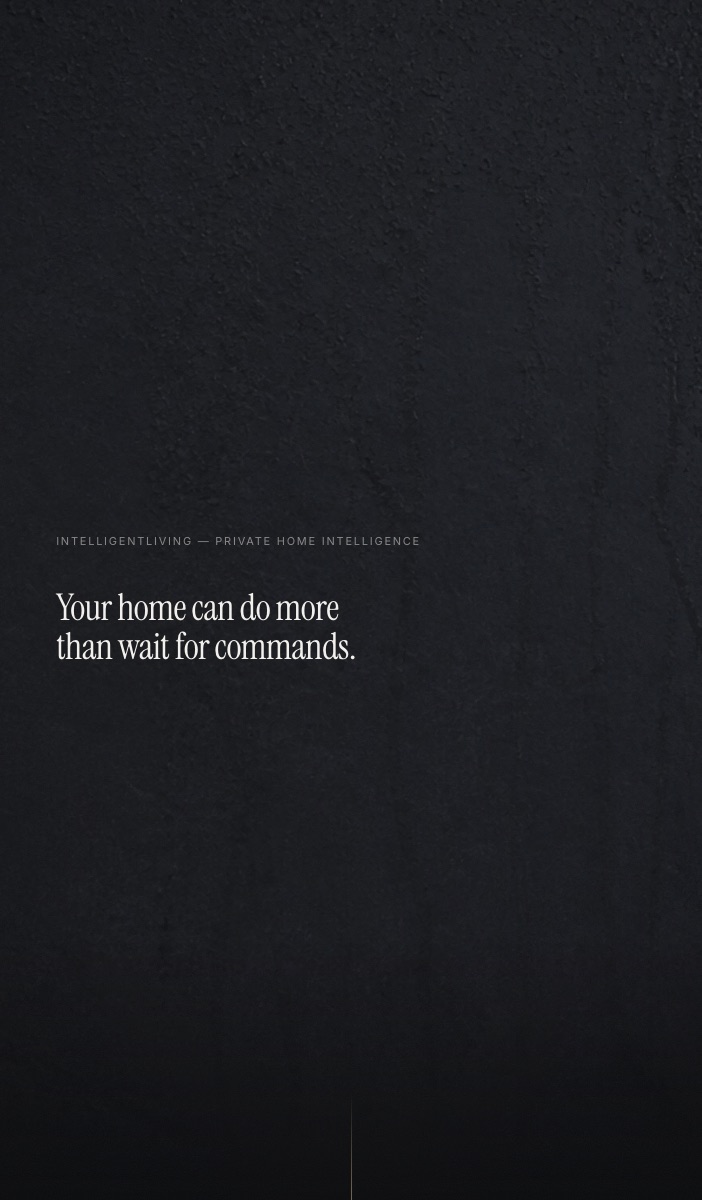
A dark stone facade with the line "Your home can do more than wait for commands"
Personal · Concept

IntelligentLiving

A home that understands situations instead of waiting for commands, and takes the small everyday decisions off your hands. The goal is not more smart home — it is less for you to think about: no setting things in the morning, no checking whether everything is switched off, no app for every part of the house, no rules for you to maintain.

Question Can a home be intelligent without becoming the next interface that demands your attention — and stay privacy-first in its architecture rather than only in its marketing?
Methods An intelligence layer above existing home automation, separated from it by a deliberate boundary: the layer forms an intent, the house decides locally what follows from it. A language model proposes; it does not act. Where processing happens is decided per class of data rather than once for the whole product, and the system degrades in stages so that a lost connection costs intelligence, not function. Automation is split into doing, coordinating and anticipating, with cost, reach and safety deciding what may happen without confirmation.
Outcome A worked concept covering the context model, the local/remote boundary, and a two-stage concierge — AI for what is digital and clearly ordered, a person where a person is the better answer. Including a room device deliberately built without display, logo or permanent status light, because the technology is meant to disappear rather than announce itself.
Home Intelligence Privacy-first Local Inference Concept Design
Coming soon · intelligentliving.fuxiq.at
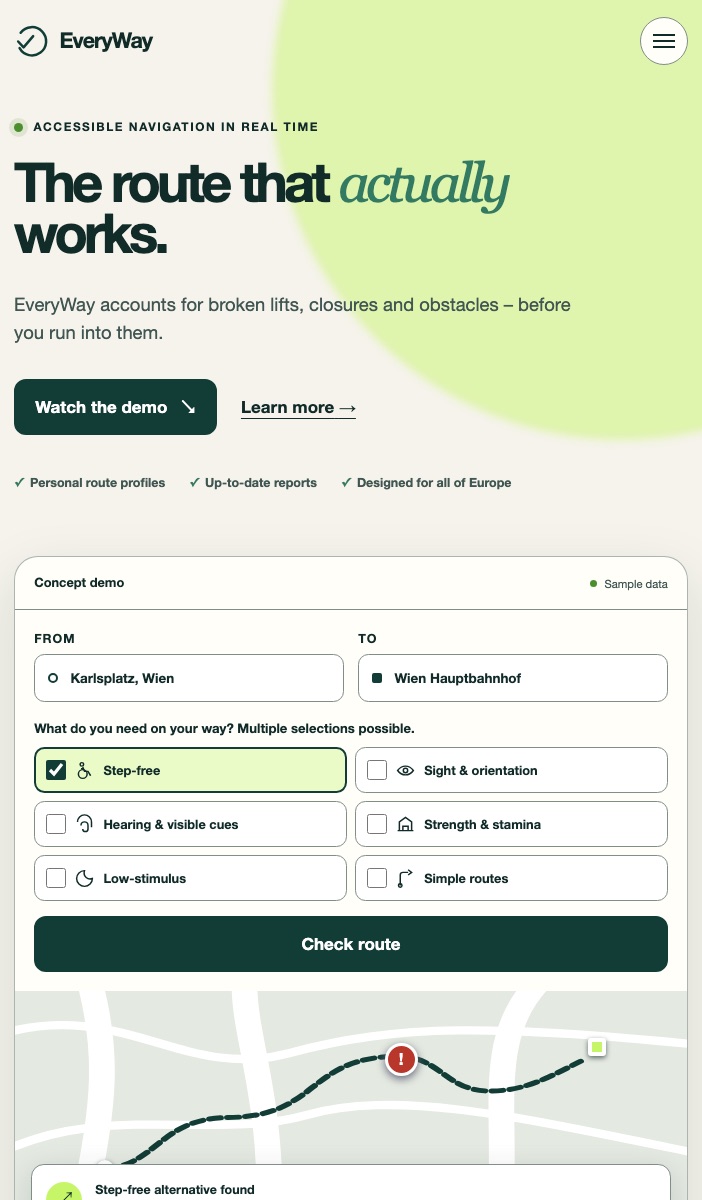
The EveryWay concept demo, with six route profiles and a step-free alternative around a broken lift
Personal · Concept

EveryWay

A route can work on the map and still be impassable in reality. A single broken lift is not a minor inconvenience — if it is the only step-free access to a station, the route does not get longer, it disappears. EveryWay plans journeys that already know the current state of the infrastructure and reroute around it before somebody is standing in front of the problem.

Question What does a routing system need to know — about the network’s current state and about the person travelling — before its shortest path is actually a usable path?
Methods Six combinable need profiles — step-free, vision, hearing, stamina, low-stimulus and simple routes — instead of one accessibility filter; static infrastructure from OpenStreetMap tagging joined with operator real-time disruption feeds and community reports that carry confirmation and expiry; participatory development with self-advocacy organisations, and EN 301 549 from the first line rather than at acceptance testing.
Outcome A documented concept: the data already exists and is openly licensed — the work is in connecting it. Gap analysis against Wheelmap, operator lift-status services and academic OSM routing prototypes shows nobody joins static infrastructure, multi-operator real-time status and community knowledge into one continuous door-to-destination route. Positioned against existing obligations (UN CRPD Art. 9, National Action Plan on Disability 2022–2030, BaFG), with the open points — advisory board, first user research — stated rather than hidden. One building block is already specified in detail: beacon-guided wayfinding for the places where GPS gives up, with the accessibility graph held offline on the device, reports tied to a confirmed beacon so that they carry weight, and the WU Vienna campus as the first pilot area — small enough to survey, public, and mixing indoor and outdoor space.
Accessibility Routing Real-time Data OpenStreetMap Participatory Design
Visit the site →
Research

Bachelor Thesis.

Multi-agent knowledge graph traversal against hallucination — at WU Vienna.

Title
Reducing Hallucinations in LLM-Based Question Answering through Hybrid Multi-Agent Knowledge Graph Traversal
Completed · 2026 · Grade: Excellent (1)
Abstract

Large language models produce fluent answers that nothing supports — hallucination. This thesis asks whether an open-weight model that walks a knowledge graph with several parallel agents answers more faithfully to its evidence than three text-based approaches: one-shot prompting, two-step retrieval-augmented generation (RAG) and agentic RAG. The system splits the question into clauses, finds an entry entity for each in a vector index over the graph, lets parallel sub-agents walk outward from those entries, consulting the language model only every few hops, and answers from the best sub-agent’s subgraph. Its premise is that of the Wikipedia game: the entry need not be exact, because the walk will pick up the trail.

The evaluation has two phases on Wikidata: a medical subgraph against an external benchmark, then a skeleton of the complete graph against question sets it answers by construction, once with an entry index that contains the answer entities and once with the system’s own.

The intended outcome — more faithful at comparable accuracy and lower cost — is not reached. The first phase separates the graph system from nothing. In the second, a single-agent walk given a correct entry is more accurate than one-shot prompting and agentic RAG and about as faithful as the text baselines; with the system’s own index neither graph arm beats the ungrounded baseline, because most walks return no fact. The graph does not mislead; it is absent. The walk picks up the trail only when it starts beside it, and the multi-agent layer adds no significant accuracy at many times the cost.

The contribution is a located bottleneck — entity linking against a whole-graph index — and its repair: looking the question’s names up in the graph’s own label table, which lifts the single walk close to the diagnostic ceiling at fewer model calls. The result vindicates the traversal, not the system built around it.

Research Focus

  • Hybrid seeded traversal with parallel sub-agents
  • Accuracy and faithfulness scored separately
  • Entity linking as the located bottleneck
  • Compared against one-shot prompting, two-step RAG and agentic RAG

Technologies & Methods

  • Wikidata truthy · Fuseki · SPARQL
  • Neo4j · Qdrant · Qwen3 embeddings
  • LangChain · LlamaIndex · LiteLLM
  • Ollama · vllm · open-weight LLMs
  • Python · MLflow · Langfuse
Education

Background.

2026 – today

Vienna University of Economics and Business (WU)

Master of Science · Digital Economy
Currently enrolled.
2022 – 2026

Vienna University of Economics and Business (WU)

Bachelor of Science · Business Informatics
Specializations: Data Science & Production Management.
Completed
2016 – 2021

HTBLA Steyr

Engineering Diploma · Electrical Engineering & Communications Technology
Telecommunications engineering, PCB design and embedded systems.
Graduated with Distinction
Skills & Stack

Technical Profile.

Technologies and domains I work with across enterprise, AI and infrastructure contexts.

Enterprise & SAP
SAP MM SAP PP SAP S/4HANA ABAP
AI & LLM
LangChain LlamaIndex Ollama vllm GraphRAG RAG
Knowledge Graphs
Neo4j Cypher RDF / OWL SPARQL
Programming
Python SQL Java C
Data Science
pandas NumPy scikit-learn
Automation & Infrastructure
n8n Docker Linux paperless-ngx Home Assistant
Observability
Grafana Prometheus Loki Tempo Alloy
Networks & Hardware
Telecommunications PCB Design Embedded Systems
Contact & Links

Get in touch.

For academic exchange, technical discussions or project-related questions, feel free to reach out via LinkedIn, GitHub or Bluesky. I am also reachable by email.